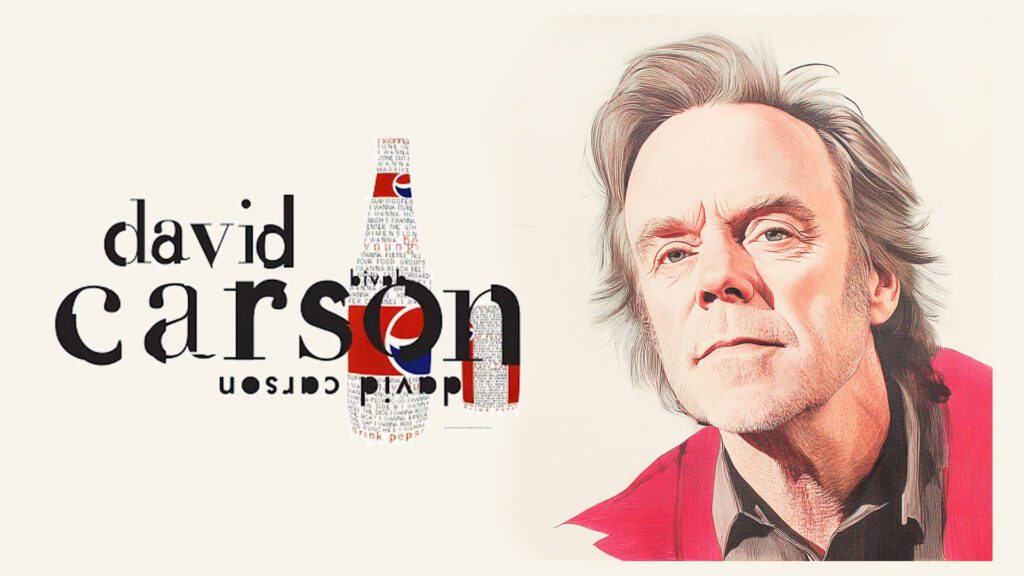
David Carson, born on September 8, 1954, in Corpus Christi, Texas, is a name synonymous with groundbreaking, rule-defying graphic design. As a pioneer of the “grunge typography” movement, Carson has redefined what it means to communicate visually, challenging conventions and inspiring a generation of designers with his distinctive, avant-garde style.
Early Life and Career
David Carson’s journey into graphic design was unconventional. Initially, he pursued a career as a professional surfer and ranked ninth in the world during the mid-1980s. His formal introduction to graphic design came later, when he attended a short course in Switzerland in 1983. Despite lacking traditional training, Carson’s unique perspective and natural talent soon set him apart.
Breaking the Mold with Ray Gun
Carson’s most influential work came during his time as the art director of Ray Gun magazine from 1992 to 1995. Ray Gun was an alternative music and lifestyle magazine that perfectly suited Carson’s experimental approach. His work there was characterized by chaotic layouts, distorted typography, and unconventional imagery. Carson’s designs often pushed readability to the limit, prioritizing visual impact and emotional response over traditional legibility.
- Distorted Typography: Carson’s use of grunge typography, where type was often distressed, overlapped, or arranged in seemingly haphazard ways, created a visual language that resonated with the magazine’s alternative and rebellious spirit.
- Emotional Imagery: He frequently used abstract and fragmented images to convey the mood and tone of the articles, further enhancing the reader’s emotional engagement with the content.
Notable Works and Impact
Beyond Ray Gun, David Carson has worked with numerous high-profile clients, including Pepsi, Nike, Microsoft, and MTV. His distinctive style has left an indelible mark on various advertising campaigns and branding projects, demonstrating his ability to adapt his unconventional approach to mainstream commercial work.
- Nike: Carson’s work for Nike, particularly his ad campaigns, embraced his signature aesthetic of bold, disruptive design that captured the dynamic energy of the brand.
- Pepsi: For Pepsi, Carson created ads that were visually striking and reflective of the brand’s youthful and energetic image, breaking away from traditional advertising norms.
- The End of Print: In 1995, Carson published “The End of Print,” a book that chronicled his groundbreaking work and design philosophy. The book became a bestseller and has been hailed as one of the most important graphic design books of the era.
Design Philosophy
David Carson’s design philosophy is rooted in the belief that design should be intuitive and driven by emotion. He famously stated, “Don’t mistake legibility for communication.” For Carson, the effectiveness of a design is not solely determined by its clarity but by its ability to convey a message and evoke a response.
Carson’s work often blurs the line between design and art. He treats each project as an opportunity to explore new visual languages, driven by the belief that there are no fixed rules in design. This approach has made his work unpredictable, engaging, and deeply personal.
Teaching and Influence
David Carson’s impact extends beyond his professional work. He has taught and lectured around the world, sharing his insights and inspiring the next generation of designers. His workshops and lectures are known for their emphasis on creativity and breaking free from conventional design constraints.
Legacy and Recognition
David Carson’s contributions to graphic design have been widely recognized and celebrated. He has received numerous awards, including the AIGA Gold Medal in 2014, which honors his profound impact on the field. Carson’s work continues to be studied and admired for its innovative approach and its challenge to the status quo.